


Newsletter of the main news 15.12/21.12
All newsDate
21 Dec 2025

- Telegram


1️⃣ Frozen Russian Assets
The UK government has given Roman Abramovich a “final chance” to transfer £2.5 billion to Ukraine from the sale of Chelsea Football Club. If he fails to do so, London is prepared to initiate legal proceedings to forcibly redirect the funds to support victims of the war. The money has remained frozen in UK accounts since 2022 and may be used exclusively for Ukraine’s benefit.
Russian security services conducted an intimidation campaign targeting Belgian politicians and the management of Euroclear over frozen Russian assets. The targets included senior officials of the depository holding the majority of the Russian Central Bank’s reserves. The threats are linked to the EU’s intention to use these funds for Ukraine. Russia has publicly described such steps as “theft.”
Finland seized a villa belonging to sanctioned Russian oligarch Boris Rotenberg due to unpaid property taxes. Because of sanctions, he is unable to transfer funds to Finnish banks, resulting in mounting debts. Finnish authorities had previously seized and sold other properties linked to him over financial liabilities. The sanctions regime effectively blocks the use of such assets within the EU.
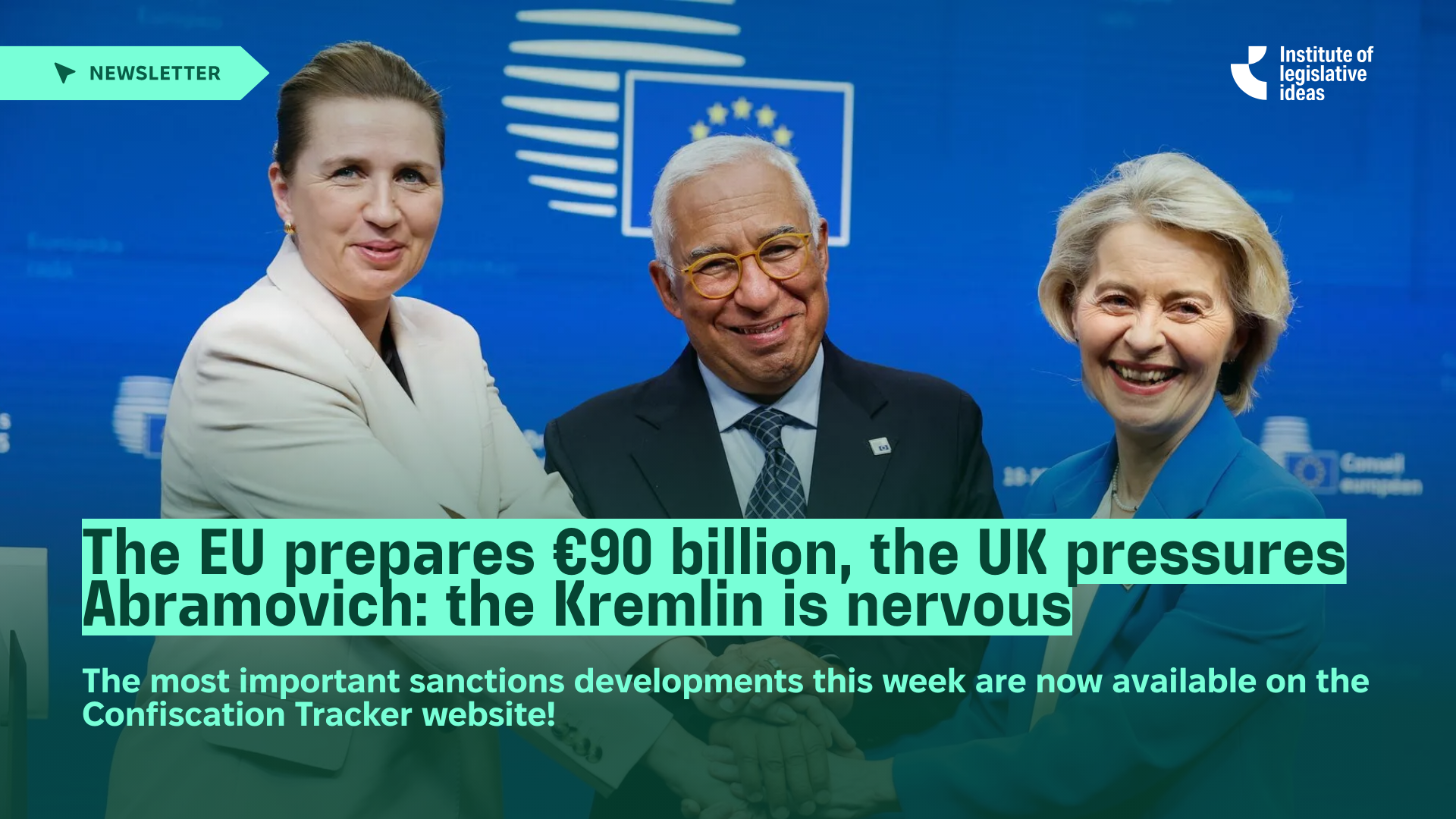
The EU approved €90 billion in financial assistance for Ukraine for 2026–2027 in the form of an interest-free loan. The loan will be backed by the EU budget and repaid only after Russia pays reparations. Frozen Russian assets will remain immobilised and may be used to service the loan. The decision was supported by 25 EU member states.
The UK stated that it will not use frozen Russian assets to support Ukraine unilaterally. London is prepared to act only jointly with G7 and EU partners. At the same time, the UK reaffirmed its separate commitment to provide Ukraine with £3 billion in annual military assistance at least until 2030.
2️⃣ International Sanctions Policy
The EU expanded sanctions against Belarus by introducing new criteria allowing restrictions for hybrid actions threatening the Union’s security and democratic order. These include information manipulation, interference with democratic institutions, and damage to critical infrastructure. The decision followed incidents involving meteorological balloons launched from Belarus that disrupted operations at Vilnius airport and civil aviation.
The EU is not considering lifting sanctions against Russia, even amid peace negotiations, according to EU High Representative Kaja Kallas. Instead, the Union continues to intensify pressure, including permanent sanctions against Russia’s so-called “shadow fleet.” Dozens of vessels and related individuals have already been sanctioned, significantly reducing Russia’s oil revenues and its capacity to finance the war.
The Council of Europe has established a Claims Commission to compensate damage caused by Russia’s aggression against Ukraine. The new body will serve as a central international mechanism for decisions on reparations and compensation. It operates based on the existing Register of Damage, which has already received over 85,000 claims. The convention is open to accession by states worldwide.
Russian wines were removed from the San Francisco International Wine Competition due to US sanctions. Organisers acknowledged that their admission had been a mistake after appeals from Ukrainian diplomats and partners in the wine community. Some wineries involved were linked to assets affiliated with Vladimir Putin. The decision confirmed that Russia’s sanctions isolation remains in force.
The EU is preparing its 20th sanctions package against Russia, expected to be adopted by the fourth anniversary of the full-scale invasion. The European Commission is already working on the package, while discussions among member states have not yet begun. Presentation is expected in January 2026, followed by rapid adoption.
The EU also imposed sanctions on an additional 41 vessels belonging to Russia’s shadow fleet. The ships are banned from entering EU ports and from accessing maritime and logistics services. The list includes oil tankers, vessels transporting military cargo, and ships involved in the export of stolen Ukrainian grain and cultural property. The total number of sanctioned vessels now stands at nearly 600.
The UK expanded sanctions by adding 24 new listings targeting Russia’s energy sector and associated individuals. Sanctions were imposed on major Russian oil companies as well as Pakistani oil magnate Murtaza Lakhani and his business structures. The measures target oil trading chains, including companies and terminals operating outside Russia.
Following the EU ban on transiting Russian LNG to third countries, imports of Russian gas to Belgium increased significantly. Russia redirected supplies into the European network due to blocked exports to Asia. Within several months, volumes exceeded previous annual levels by more than two-thirds. A full EU ban on Russian gas imports will enter into force in 2027.
The United States temporarily suspended sanctions against several Russian banks, allowing limited operations until June 2026 for civilian nuclear energy projects. At the same time, Washington lifted restrictions on several foreign companies previously involved in supplying Russia’s military-industrial complex. All other financial and trade transactions with sanctioned entities remain prohibited.
3️⃣ Sanctions Violations and Evasion
The occupying authorities in Crimea announced the illegal “nationalisation” of property belonging to Oleksandr Usyk and 84 other Ukrainian citizens. The list includes businesses, real estate, and assets of military personnel and volunteers. The occupiers openly use property seizures as a tool of pressure against individuals deemed disloyal to Russia. Thousands of assets have been seized in Crimea in recent years.
Latvia may halt the transit of natural rubber to Russia after uncovering large-scale shipments through its territory. Last year, 86% of EU exports of this material to Russia passed through Latvia, where it is used for military aviation. Latvian security services are investigating potential sanctions violations. Latvia is pushing to include natural rubber in the EU’s 20th sanctions package.
4️⃣ Ukraine’s Sanctions Policy
A company linked to Russian oligarch Andrey Molchanov has filed a €100 million arbitration claim against Ukraine over the confiscation of the Aeroc plants. The case was submitted to ICSID, alleging violations of the Ukraine–Germany investment protection agreement. The asset was confiscated by a ruling of Ukraine’s High Anti-Corruption Court as part of sanctions against Russia’s LSR Group. Ukraine is preparing its defence and has engaged international legal advisers.